July 5, 2023 · Culinary Journalist

You don't just shake off 38 years of Stadtlander. I speak to Teddy on her very last day as owner of Stadtlander on Poelestraat in the city. She is restless because she has just gone through a very busy period finalizing the sale. She was the store manager for eight years, and the owner for the last 30 years. And now she has sold it. She is quitting. She only has to count the inventory, and then her time is up. The end of an era.

Teddy used to work at Salle a Manger when her boss City dweller bought it; she herself was studying pedagogy at the time. She didn't yet have the ambition to continue in the hospitality industry—or at least, she had promised herself not to ‘stick around’ in it. That is how she explains it. She resisted it. By her own account, because it was still looked down upon back then. ‘In that period, you often still had pub owners who were alcoholics, with a big belly and a cigarette in their mouth,’ Teddy says. ‘That was really the image of the hospitality industry back then.’

At a certain point, she could no longer ignore it and accepted that the hospitality industry ran like a common thread through her life after all. She continues: ‘Then I stopped my studies, obtained my hospitality qualifications, and became a manager at Stadtlander.’
‘We were one of the first eat-in cafes in Groningen, perhaps even in the whole of the Netherlands,’ Teddy says proudly. ‘Eating and drinking at the same time—you hardly saw that anywhere back then. That was truly new. In the past, you had a cafe or a restaurant, but this concept combined them. It made dining out much more accessible.’

From the very beginning, the Stadtlander menu also featured vegetarian daily specials. Which was quite progressive for that time. ‘Furthermore, satay, steak, and plate service,’ says Teddy. ‘But you could also get cordon bleu or schnitzel here.’ Although City dweller Although the basics remain the same, quite a few things have changed over those 38 years. ‘The menu is a bit more extensive because people really do go out for dinner more often and for more elaborate meals. But we are still very clearly a café,’ she continues. ‘On Fridays and Saturdays, after nine or ten o'clock, we are truly a café.’

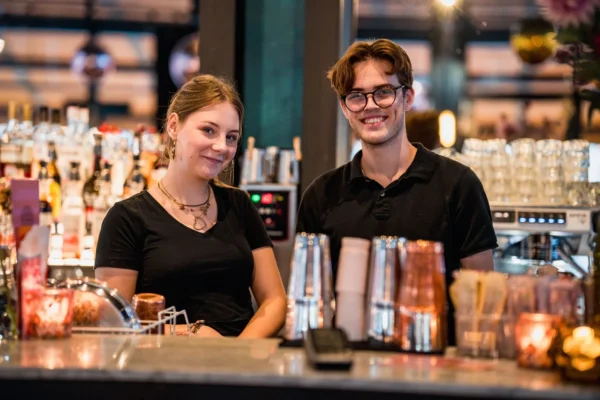
And that is, after all, the place where Teddy feels most at home. For all those years, she mainly worked behind the bar. And things have really changed there too compared to 38 years ago. ‘Now you have much more choice in beer, and many more specialty beers too,’ she says. ‘I used to have two Heineken taps; you’d stand side by side, tapping into those stacking glasses at the same time. You don’t see that at all anymore. Back then, you’d walk through the place with towers of stacked lager glasses meters high, hanging all the way over your shoulder.’

Working right in the city's nightlife district for 38 years. Has that changed? ‘You do notice that things have become a bit tougher these days,’ says Teddy. ‘That’s why most establishments have bouncers. And I hear stories from my staff sometimes too. But recently I was working a Saturday night myself again and I thought: ‘Oh my god, what is happening here? Everyone is getting so drunk!’ But then again, it was like that back then too; I am older now, of course. Nowadays, a lot of other substances are used, like pills. But on the other hand, they weren't exactly angels back then either, you know; I think that’s nonsense to say.’

What are Teddy's plans? What is she going to do with the seas of time she now has after selling her own business? "I really don't have a single idea yet," she says. "Maybe I'll go back to work, but at this moment I have absolutely no idea." What she does know is that she is going to take her dog for a nice walk on Texel first. "And then I'll see," she concludes.