April 20, 2020 · Team HG
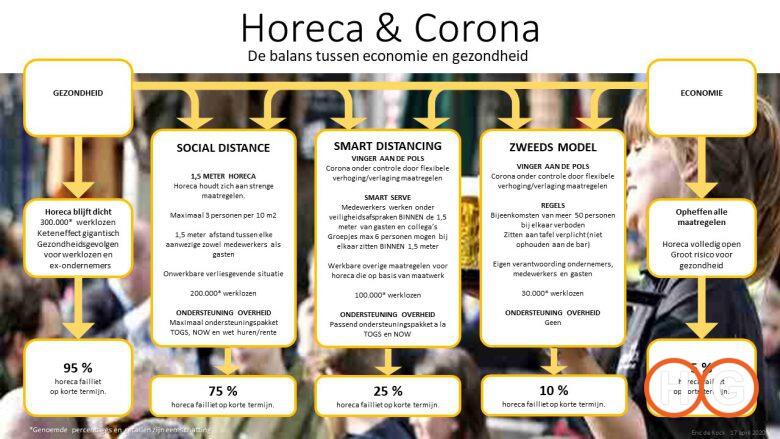
With another important government press conference following on Tuesday, and decisions to be made in the coming weeks on whether, when, and how the hospitality industry can reopen (gradually) after the ‘intelligent lockdown’, the time for formulating future plans and visions has begun. It is logical that this reopening will not go from zero to one hundred percent overnight, and the reality is that the hospitality industry will look different for the time being. Hospitality entrepreneurs Gabriella Esselbrugge (Dames van de Jonge Hotel – Restaurant & Giethoorn Hospitality), Laurens Meyer (Meyer Beheer: including De Drie Gezusters & Grand Hotel De Doelen), Marcel Hansen (IJkgebouw: drink eat relax), Jan Reuvers (Walibi World), and Eric de Kock (Café Walzicht) share their views on the balance between economy and health following the reopening of the hospitality sector.
As a former Internal Advisory Board of KHN, the group of entrepreneurs has jointly drawn up recommendations for a workable hospitality industry that is cost-covering (perhaps even profitable) for a large proportion of businesses and safe for both employees and guests. The classic hospitality landscape, the public cornerstone of society, will likely disappear forever if rigorous measures are not taken adequately. In this regard, the following points are recommended to save the hospitality industry.

There is one unique characteristic of the hospitality industry that applies to all of them: our hospitality. This is our greatest asset and our shared Unique Selling Point. This ‘USP’ lies largely in the hands of the service staff. They guard this holy grail of the hospitality industry. That is impossible at a distance of 1.5 meters. Guest contact is necessary not only to perform physical actions but is also a crucial part of the guests' experience; the very reason to visit a hospitality venue in the first place. Furthermore, the hospitality industry is not set up to allow colleagues to work continuously at a distance of 1.5 meters from each other and the guests. Creating a situation where this is possible is often impossible. The hospitality industry is therefore a contact-based industry.
The RIVM indicates that face masks can be a solution for contact professions such as hairdressers and physiotherapists. Consequently, this is also a solution to allow hospitality staff to work within 1.5 meters of each other. A work protocol must be established for hospitality staff enabling them to work safely with minimal risk within 1.5 meters of each other and the guests. Think of specific work agreements regarding frequent hand washing, wearing a face mask, minimizing contact moments, and so on. We call this ‘smart distancing.
If the fact that working in the hospitality industry is a contact profession is ignored, the hospitality industry is dead. There is absolutely no point in reopening if hospitality staff cannot work within 1.5 meters of each other and the guests.
Staying in hospitality venues will look different under smart distancing. We cannot practically assume a distance of 1.5 meters per individual, but we want groups to be able to stay safely separated from each other by means of 1.5-meter distance/partitions. For the time being, let us assume that groups may consist of a maximum of 6 people. The group itself bears responsibility for its composition, preferably consisting of people from the same household. First of all, the group must indicate that no one in the group has COVID-19 symptoms or a cold and will adhere to the house rules. Additionally, the group should preferably be seated and remain in the same place as much as possible. The only reasons for moving are arrival, departure, and toilet visits, so movement must be limited to a minimum.
We hope that, regarding the measures, reliance will primarily be placed on the common sense of the entrepreneur. A good entrepreneur takes not only the measures but, above all, the objective seriously. The objective is to limit the risk of infection to a minimum. That is what it is all about, and in addition to measures, common sense is especially needed for this. You may hold an entrepreneur accountable for this. We aim for a package of outline measures and a protocol outlining the practical possibilities and limitations of how to make a hospitality business safe, while offering the entrepreneur a certain degree of freedom to implement this.