August 26, 2025 · Team HG
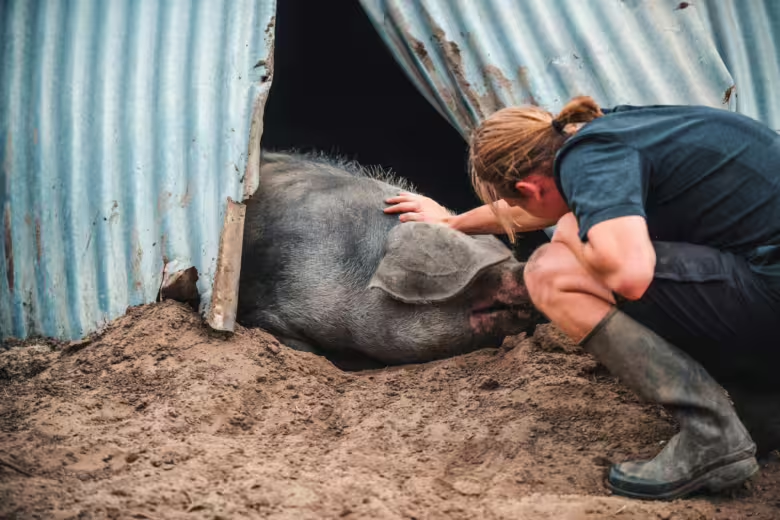
The pigs of Edwin and Petra Spa from the Waddenslager in Uithuizermeeden are happy and healthy pigs. Their pigs always roam outdoors, are fed residual streams, and live longer. But they are not ‘organically certified’. Yet their meat is more honest than many other cuts that *do* have a green label. Together with Hans and Jitka Over from restaurant Voilà en Feu in Groningen, they show that truly sustainable food begins with visibility, trust, and craftsmanship.

For Edwin and Petra, it all started with a remark from their daughter: ‘We eat organic meat, but did those animals actually have a good life?’
A simple question with major consequences. The couple, one of whom worked in childcare and the other in the timber trade, both without any agricultural background, set out to investigate. What they saw on farms, even at organic farms, did not meet their expectations. ‘We thought, if that is what we have to eat, then we might as well just start raising pigs ourselves.’ No sooner said than done. They rented a plot of land in Uithuizermeeden and started with four pigs. Not as entrepreneurs, but as parents who wanted to know what was on their plate.


But four pigs became forty. And soon, friends and neighbors wanted to buy meat too. Instead of slaughtering, Edwin and Petra decided to have their animals bred. ‘We were a bit attached to those little creatures,’ says Petra. ‘But then suddenly we had forty pigs. That’s when you become a serious pig farmer in one fell swoop.’ What started as an idealistic private project slowly grew into a business with a clear mission: good meat, from happy animals, without intermediaries.

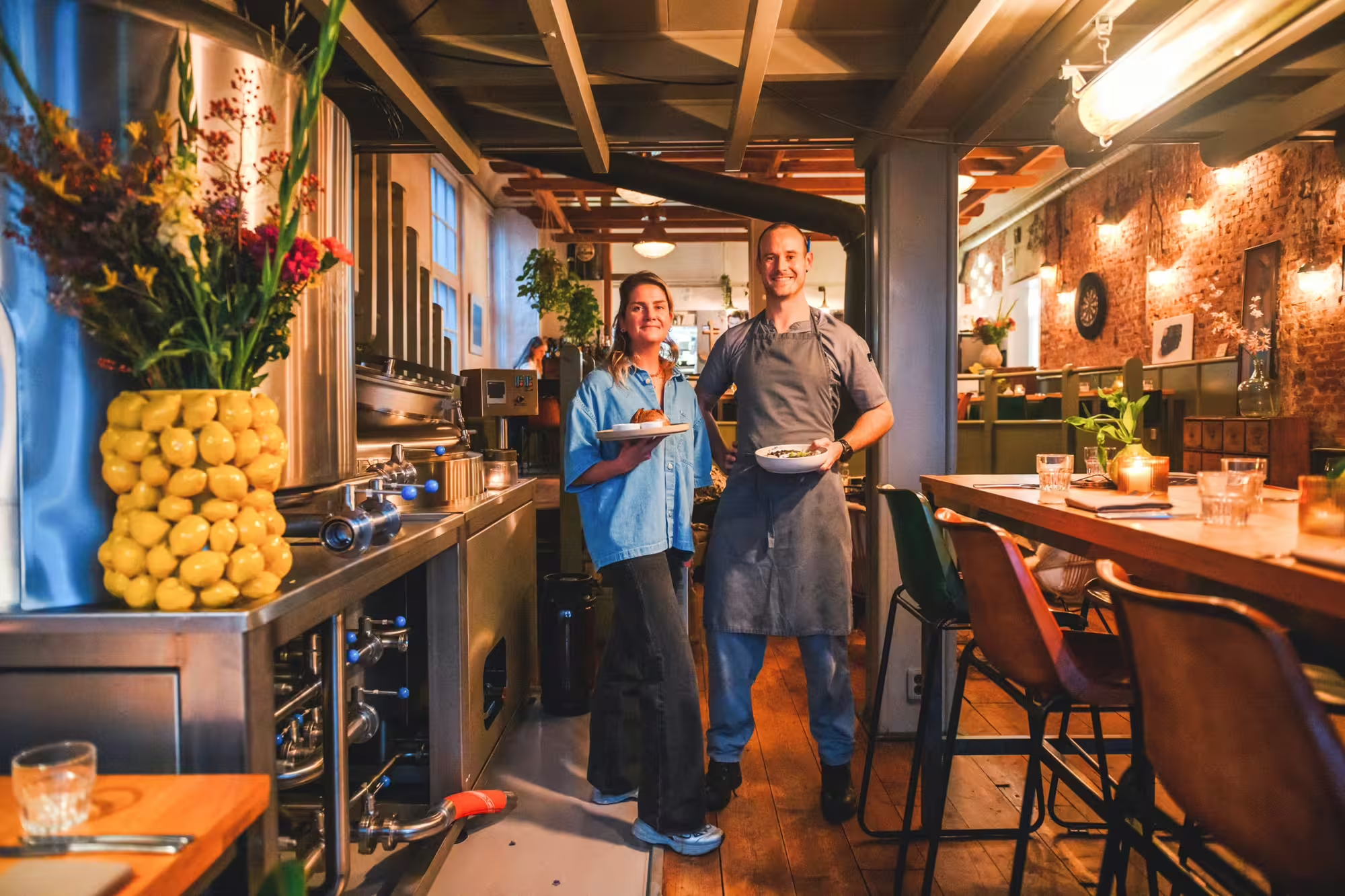
Also at Voilà en Feu It started with a vision. Hans and Jitka, both active in the hospitality industry for many years, decided to open their own restaurant in Groningen in 2011. They opted for a concept that was still unusual in the Northern Netherlands at the time: a single fixed five-course menu, based entirely on seasonal products, with attention to every detail.
From the very beginning, everything revolved around personal attention, for the guest and for the product. ‘Exceed the expectations,’ says Jitka. ‘You are always one step ahead. No one has to ask for anything.’
They were also pioneers in transparency. Online reservations were always followed up personally by phone. The result: hardly any no-shows, strong customer loyalty, and the opportunity to tell their story—about origin, preparation methods, and the farmers and butchers behind the plate.


That transparency was carried through in Voilà, making it even more visible to the guest. Literally, even, when another pig farmer they used to work with came to deliver his ham himself during dinner—and thus to a full restaurant. ‘We asked him: could you come a little later? Then all the guests will be there and they can see you come in with that ham on your neck,’ laughs Hans.

That direct line makes the difference. ‘‘Guests really appreciate that,’ says Jitka. ‘It’s not just a nice piece of meat, but it’s a story. And you can taste that.’
The collaboration between Voilà en Feu and the Wadden butcher It came about spontaneously. Hans and Jitka had become curious about the pigs they saw walking around in Meerstad and decided to just pay a visit. ‘‘A piece of pasture with a thirty-centimeter electric fence. You step right over it, and suddenly you’re standing among dozens of happy pigs,’ Hans recalls. During the corona period, the contact grew into a full-fledged collaboration.

For Edwin and Petra, as well as Hans and Jitka, sustainability is not a stamp or a sticker. It is a choice. A series of choices, actually, every single day. Pigs given a second or third chance. Chicken with muscle mass, instead of white, watery meat. Lamb necks slow-cooked for three days. Mackerel instead of tuna. Although even the latter isn't such a given anymore these days.
Organic is a trickier concept, Hans explains. ‘We regularly get calls asking if we are an organic restaurant. We aren’t, I answer. Sometimes people then say: Oh, then we won’t come. And that is a shame, because organic isn’t everything, of course. You can cycle to the supermarket for organic meat that is imported from Africa or South America. That is certainly not sustainable. I’d much rather have something from the local area.’
‘Our ecological footprint might not be lower than that of the industry,’ Edwin says honestly. ‘But our animals have had a good life. And the customer knows what he is eating. That is sustainability to us. And every pork chop we sell is one less for the big industry—that is how we see it.’


Hans adds: ‘Anyone can put a ribeye on the menu. But that is only a fraction of the animal. What do you do with the rest? We make something beautiful out of that other 98%.’
‘What still bothers me sometimes,’ Edwin continues, ‘is the amount of plastic we have to use. You simply can’t avoid it. A lot of meat is vacuum-sealed for the freezer. We now have the advantage that we can sell a lot of fresh produce in our store. And that can also be done in paper, or customers bring their own containers, which is even better.’
The strength of their collaboration lies in simplicity. No wholesalers, no detours, no opaque logistics. The pigs are born, raised, slaughtered, and processed by Edwin and Petra. Hans and Jitka sometimes pick up the meat themselves, or Edwin delivers it. There is no middleman. That makes the story short, and powerful.
‘It sells itself,’ says Hans. ‘But it helps that we tell people about it too. You are ambassadors for each other.’ Petra agrees: ‘Our customers know they are always welcome to come and take a look. Everything is visible.’ And no, they don’t use social media. Petra says dryly: ‘No interest. I’d rather be with the pigs than behind a computer.’ Yet their visibility is enormous, precisely because of their openness and transparency. And not just in Groningen; they deliver throughout the Netherlands.


What both parties want is for people to start looking at what they eat differently. Not necessarily organic, not perfect, but conscious. Hans: ‘We have regulars who have been coming here since the very beginning, and who have really changed their eating habits over the years. That’s wonderful. That’s what you do it for.’
And it is not always easy. Availability sometimes remains a challenge. Some farmers are still dependent on a single large buyer. But that is changing, partly due to collaborations like this. Hans and Jitka also advocate for more cooperation among restaurants. ‘We all face the same challenges: energy, personnel, suppliers. Let’s learn from each other.

What Voilà en Feu And doing De Waddenslager has nothing to do with big words, but everything to do with honest choices and the courage to do things differently, or perhaps exactly the way it should be done and the way it used to be done.
‘Our pork belly slices are the real pork belly slices, just like you used to eat them,’ says Petra. And there’s not a word of a lie in that…


After fifteen years, Jitka & Hans are saying goodbye to their restaurant Voilà in Groningen. What started as their dream grew into a place full of memories, hospitality, and culinary experiences. The restaurant will close its doors permanently at the end of September. Until then, from August 13 to September 27, 2025, they will return to the essence of Voilà with surprise menus for lunch and dinner. After the closure, the entrepreneurs will continue their activities in catering and events.

Read all about the Green Choice? The Green Choice is a project in which Groningen hospitality entrepreneurs, chefs, and local producers collaborate to make sustainable food routes visible. Through portraits, interviews, videos, and cooking demonstrations, the journey of local products—such as grains, potatoes, game, and shrimp—from producer to dish is visualized. The project promotes the short supply chain, strengthens regional cooperation, and offers inspiration for both hospitality professionals and conscious consumers. De Groene Keuze is an initiative of the Foundation for Economic Cooperation Northern Netherlands supported by the Province of Groningen and Municipality of Groningen
© 2025 ESNN Foundation
Text: Tanja Tuinstra
Photography: Jasper Bolderdijk