December 1, 2017 · Team HG
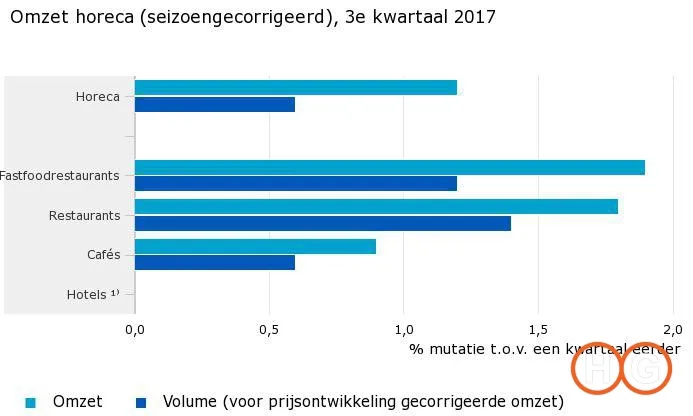
DThe turnover of hotels, restaurants, and cafes rose by 1.2 percent in the third quarter of 2017 compared to the previous quarter. This is evident from the Hospitality Quarterly Monitor presented by Statistics Netherlands (CBS) on November 30. The volume—the number of consumptions and overnight stays—increased by 0.6 percent. All in all, a good third quarter in 2017 for the hospitality industry.
Robèr Willemsen, Chairman of KHN: “Just as in the first and second quarters, we are seeing positive figures in the hospitality sector in the third quarter as well. Our members are benefiting from the favorable economic climate and the fact that people are consuming more in Dutch hospitality establishments. I am pleased about that. However, we also see that the costs for hospitality businesses are increasing, partly due to the rising commissions that must be paid to search, booking, and delivery platforms such as Booking.com and Thuisbezorgd.nl. As a result, the margins of many hospitality businesses are under pressure. After all, higher turnover does not necessarily mean that a company is making more profit. Moreover, we see that growth is already leveling off somewhat. Something to keep in mind for the coming period.”
Within the hospitality industry, performance was good in many sectors during the third quarter of 2017. The highest revenue growth was seen among fast-service companies. This aligns with the trend that people are opting for convenience and speed and are having food delivered more frequently. Revenue from fast-food restaurants consistently showed the strongest growth, at 1.9 percent. Restaurants saw a 1.8 percent increase in revenue. Revenue from cafés, including eateries and coffee bars, rose by 0.9 percent. Hotels had the same revenue as the previous quarter.

Many new hospitality businesses are still being added: 750 new businesses in the third quarter of 2017, even more than the 500 new businesses that were added in the second quarter. In addition, it is clear that costs are rising: higher rent and beer prices, and increasing commissions that online platforms charge restaurants and fast-food businesses for, among other things, meal delivery. If a hospitality entrepreneur pays excessive commissions to an online platform while receiving the same amount for the delivered meal, this naturally comes at the expense of his margin/profit.
KHN is therefore advocating for a level playing field for the hospitality industry and wants to prevent search, booking, and delivery sites from gaining too much power. To this end, they are in consultation with the Ministry of Economic Affairs and with politicians. In addition, they are working on solutions for labor market shortages. The number of filled vacancies remained the same this quarter, but because so many extra employees are needed, hospitality entrepreneurs will have to make an effort to retain staff. This can be achieved by properly onboarding and training employees and providing them with sufficient rest. However, as far as KHN is concerned, this also requires less rigid government legislation and regulations, so that hospitality entrepreneurs face fewer employer risks when hiring an employee on a permanent basis.
Via KHN and CBS