June 16, 2025 · Team HG
In a world where ‘sustainable’ is often merely a marketing label, there are also people who truly do things differently. People for whom respect for animals, nature, and products is not a trend, but a matter of course. Like chef Steven Klein Nijenhuis of restaurant Onder de Linden in Aduard and game butcher David Rutgers from Groningen. One cooks at a Michelin-star level, the other slaughters and sells exclusively game. Together, they are making a stand against waste, overproduction, and complacency in gastronomy.

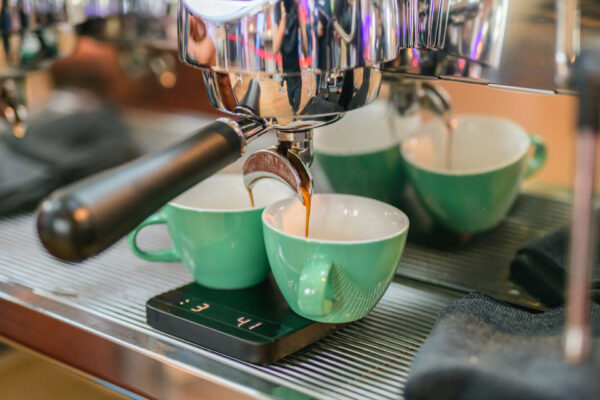
‘I do think there is something serious going on with the climate,’ begins Klein Nijenhuis, as he prepares the cappuccino with frothed oat milk. ‘I have no illusions and I certainly am not going to change it all, but I do like to show that things can be done differently.’
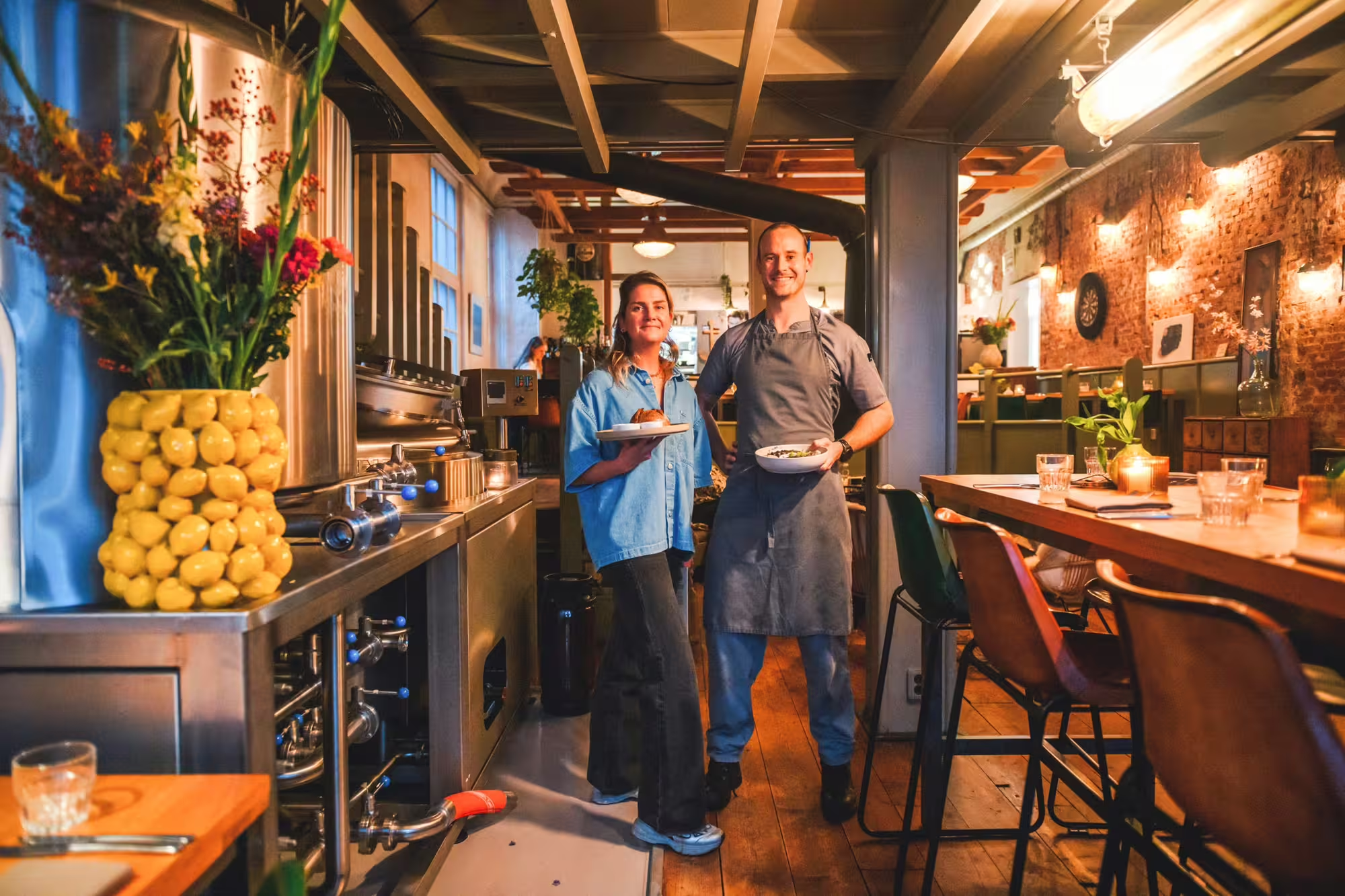
And he has been doing that with his restaurant for some time now. Herberg Onder de Linden in Aduard. In 2016, he started the business there with his then-partner. A successful restaurant, complete with a Michelin star. The menu featured luxury ingredients such as wagyu, lobster, and caviar. A year ago, he made a shift by stopping the use of those products, as well as beef and dairy. ‘You can still eat very well without those products,’ he adds. ‘Food has a huge impact on emissions, much more than people think, and much more than, for example, the car you drive.’


In addition, the decision to take a different, more sustainable approach is also an economic choice. ‘Yes, there is a financial side to it as well. I want to distinguish myself, but everything is also getting more and more expensive.
David Rutgers worked for years as a chef in his own restaurant in the city of Groningen before dedicating himself entirely to his passion: game meat. ‘Even back then, hunters regularly came into my establishment with game, and I found that very interesting right from the start. In 2015, this building became available, so I sold my restaurant and started De Wilde Slager.’

The Wild Butcher is a unique butcher shop in Groningen that sells exclusively game sourced from the local region. Or as he puts it himself: it is a shop, a butcher shop, a tasting room, and a school. The only place in Groningen where you can buy, prepare, feel, discover, touch, smell, and taste game.

And where exactly does Rutgers’ fascination with game meat come from? ‘If you eat a piece of game, for example roe deer, and you eat a steak, you will never eat a cow again,’ he states emphatically. ‘To me, beef, pork, and chicken just taste watery. Of course, you get used to it, and I am spoiled now too. And when you eat it for the first time, it might take some getting used to, but after that, it is fantastic. Moreover, game is much meatier. And the best part: those animals obviously had a wonderful life, and you can simply taste that!’
‘For me, game is the highest achievable in the world of meat,’ he says. ‘In terms of taste, sustainability, and diversity.’
The hunters knew how to find Rutgers, because very soon he was offered plenty of game at his new location as well, complete with skin and hair. ‘So that meant a lot of plucking and boning for me, something you obviously can't necessarily do as a chef. But I was already doing it a lot and had also learned a great deal from hunters and farmers, and a bit from a poultry butcher. I was constantly looking for the tastiest piece of meat. I just started messing around, and every now and then you fall on your face, but that’s the best way to learn.’


His meat comes from hunters who actively contribute to wildlife management. No farmed animals, no truckloads of soy, no industrial slaughter. ‘I know where every piece of meat comes from. Every roe deer, every goose has its own story. And I pass that story on to chefs like Steven.’
Rutgers knows he doesn't opt for convenience. Wild animals vary in size, fat content, and texture. ‘No two geese are alike,’ he says. ‘Sometimes difficult, but that is precisely the beauty of it. As a chef, you have to be able to think in terms of possibilities.’
Chef Klein Nijenhuis makes no secret of his love for the region. In his kitchen, he works as much as possible with products from the neighborhood—local. As much as possible from the province of Groningen, but the rest of the Netherlands, or even a part of Germany, are included as well.
‘Our focus is local, sustainable, and less on sourcing from far away. First, look at what is available in the neighborhood. Because we hardly use any meat anymore, we started using a lot more nuts. So we went looking for a company where we could source them. There is a company in Gelderland that supplies us with them. That might not be very close, but it is always better than nuts you get from, say, California, or who knows where else.’


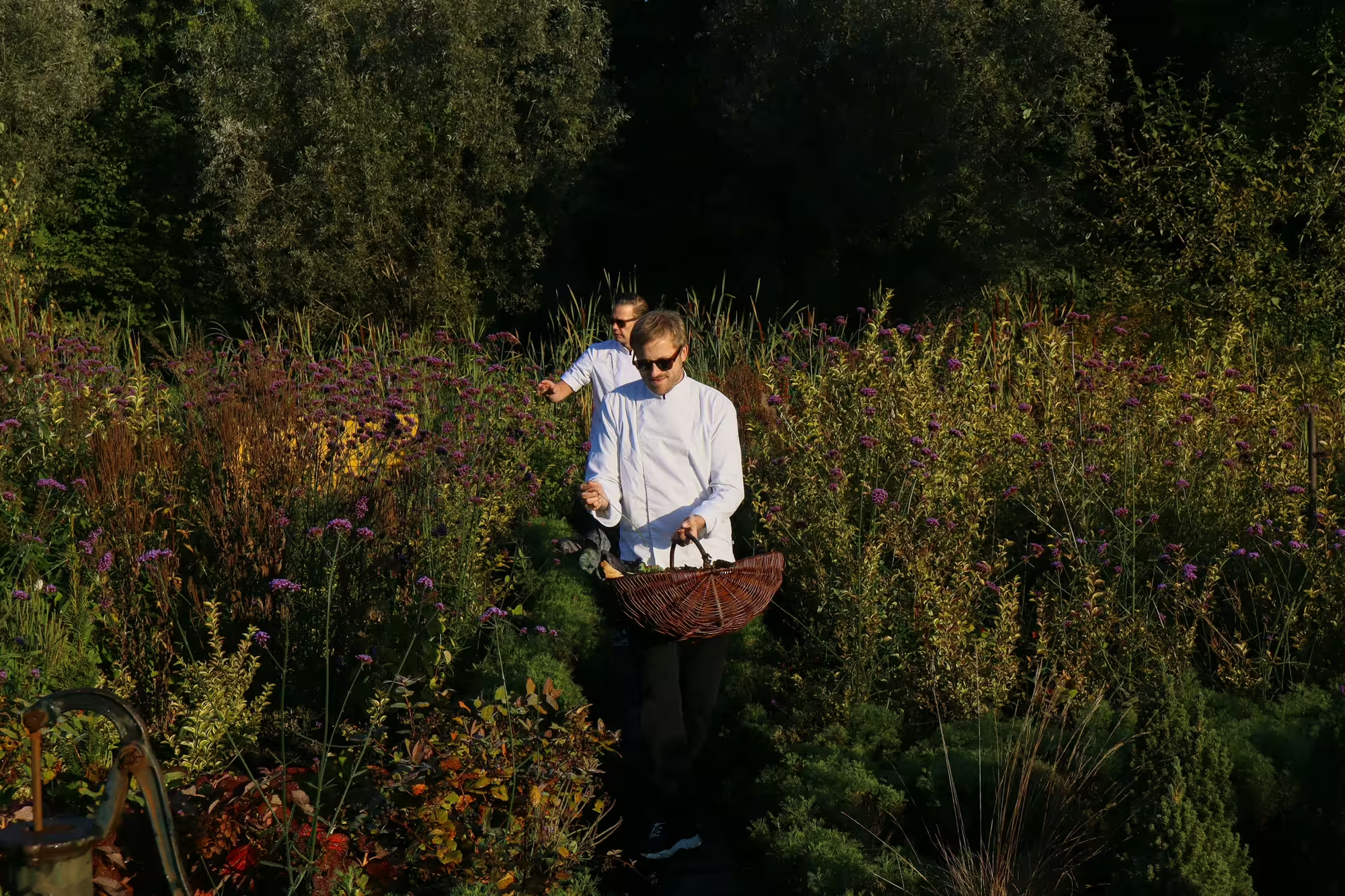
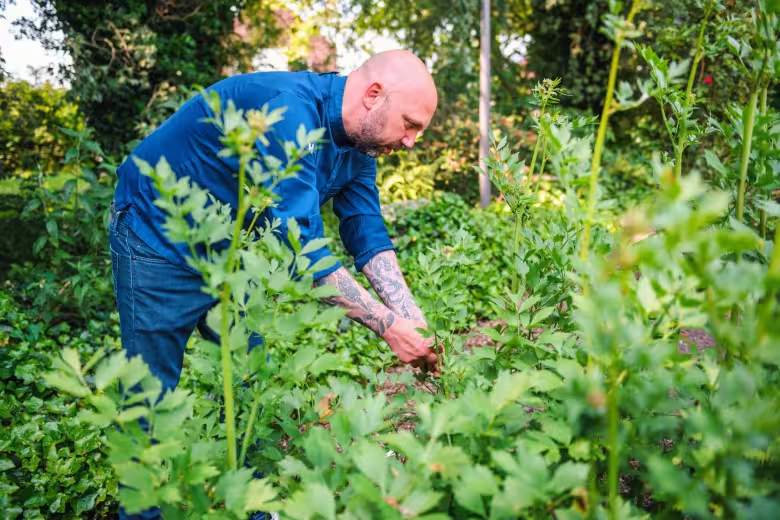
Furthermore, Klein Nijenhuis makes extensive use of vegetables and herbs from his own garden in Annen. He draws inspiration from them. ‘You force yourself to be creative when you let yourself be inspired by what grows in nature. Of course, we work with a sowing plan and know roughly what will come out of the ground and when. But even so. A carrot from Hanos always looks the same. With your own garden like this, things can vary, and sometimes you have to adjust if it turns out differently. You have to be flexible, but that is also a good thing.’
And besides that, of course, the game from Rutgers. Not only to reduce the ecological footprint, but also because he believes in the quality of the region. ‘It doesn’t necessarily have to be organic, something that naturally isn’t possible with game anyway, but it has to be honest. What grows and flourishes here, that’s what belongs on the plate.’
‘I want to show what you can make here. With simple, everyday products. Without fuss. Just good food that is also sustainable.’
Both men are outspoken about the misunderstandings surrounding sustainability. Rutgers: ‘Greenwashing is everywhere. People think local fish is sustainable, but almost no fish really is. And if a cow is local but eats soy from the Amazon, how sustainable is that?’ Klein Nijenhuis adds: ‘The consumer is often confused. What is healthy, what is good for the climate? We try to tell that story through the plate. Less animal products, more plant-based. And if you do eat meat, choose game or chicken. That is better for the climate and for your body.’

What the chef and the butcher share is a deep aversion to waste and laziness. ‘We have drifted too far away from what food actually is,’ believes Klein Nijenhuis. ‘People prefer to buy meat anonymously from a plastic container. But if you work with a deer that was still walking through the woods that morning, then you have to have respect, and you will naturally waste less.’ Rutgers adds: ‘You can’t eat steak every day. But if you do eat meat once in a while, eat something good. Something with a story.’
Bee Under the Linden That story is also embedded in the choices they make: venison instead of beef, local celeriac instead of imported avocado. Guests don't just get a plate of food, but a story. Not forced upon them, but available if they ask for it. ‘Everyone in the service and in the kitchen knows where the products come from,’ says Klein Nijenhuis. ‘So if someone asks for something, we can explain it. And people appreciate that. Knowing what you're eating, especially when it's sustainable and local. And it is; there is a lot of demand for it these days. Local is simply a great word. But if you are going to do something with it, do it right and don't just put some stupid bullshit story on your menu.’

Rutgers sees this reflected in his shop as well. ‘More and more people are interested. They want to know what they are buying and how the animal lived. And with me, they know: this was shot, not bred. No transport, no stress. Moreover, I always know exactly where the animal comes from. Those lines of communication are super short. A hunter who sells me bullshit doesn’t need to come back here.’

What binds the two is their no-nonsense mentality. No trends, just craftsmanship, taste, and shared responsibility. ‘In David, I simply have a very reliable supplier,’ says Klein Nijenhuis. ‘He is a craftsman and also very transparent, so I know exactly what I am buying from him. And we pass his story on to the guest.’
Rutgers hopes that, partly thanks to the collaboration with Onder de Linden, more people will (re)discover game. ‘I currently sell roe deer, hare, goose, and pigeon. Not everyone dares to try it, but it is honest meat. It is already there. We just have to make good use of it. And the advantage of working with creative chefs like Steven is that they are not bound by a specific delivery period. With game, you never know when something will arrive, so you have to be able to adapt.’

Green choices don't have to be complicated. Sometimes it simply starts with a single roe deer, shot in the province and processed by people who know what they are doing. And ends up as a Michelin-star-worthy dish on a plate in Aduard.

Read all about the Green Choice? The Green Choice is a project in which Groningen hospitality entrepreneurs, chefs, and local producers collaborate to make sustainable food routes visible. Through portraits, interviews, videos, and cooking demonstrations, the journey of local products—such as grains, potatoes, game, and shrimp—from producer to dish is visualized. The project promotes the short supply chain, strengthens regional cooperation, and offers inspiration for both hospitality professionals and conscious consumers. De Groene Keuze is an initiative of the Foundation for Economic Cooperation Northern Netherlands supported by the Province of Groningen and Municipality of Groningen
© 2025 ESNN Foundation
Text: Tanja Tuinstra
Photography: Jasper Bolderdijk
Video: Twan Siertsema