April 2, 2017 · Team HG
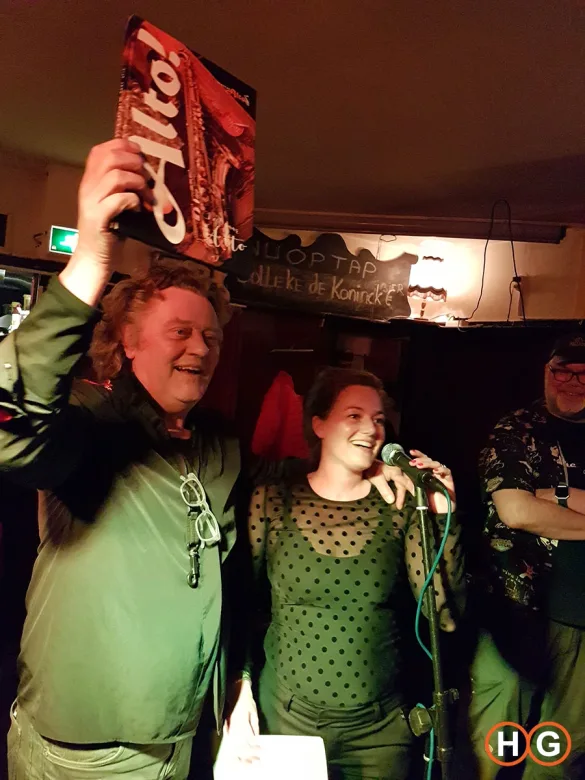
Hugo Beukema (65), with all his experience in the hospitality industry, put his heart and soul into Jazzcafé Alto for the past five years. But Alto closed down on the night of April 1 to 2, 2017. Meet the story of the proud founder of Alto. After five years, the realization is gradually dawning that he has every reason to be proud.
Jazzcafé Alto was located at number five Kleine Kromme Elleboog in Groningen. Due to renovation plans by the landlord of the building, Wijnand van Smeden, the café officially closed this weekend. On Saturday, April 1, Team Alto, consisting of Hugo, Kim, and Tertia, said goodbye to the café and its guests.
The number of guests who turned up for the farewell party on Saturday evening showed just how beloved the café was. It was a grand celebration with beautiful speeches and performances by regulars. The music of Shake Some Dust, the band that originated at Café Alto, got many people dancing and singing along. Around two o'clock, the doors closed to the public, and the Alto team, friends, and band remained behind in a small circle to wrap things up amongst themselves.
How would you describe Alto?
“As an incredibly cozy café that had to be, and was, accessible to everyone. And yes, I do hold jazz in high regard; that is something I care about, and it blends incredibly well with the crowd that frequented the place. But even apart from the jazz, it was actually a café where no one—and I think that is one of the most important things—had to live up to anything. That isn't necessary, and I find that a beautiful aspect of the café.”
So everyone could just be themselves?
Exactly. And that naturally has something to do with the interior as well. It was an old, traditional pub, so you don't have to try to act hip. You could, but it would be completely out of place. But aside from the fact that it was just a traditional pub, some incredibly beautiful things happened there in terms of jazz, especially in collaboration with the Jazz in Groningen Foundation. Almost all the really big names from the Netherlands have performed here. I find that so special.
How did you actually come up with the name Alto?
“I started out on the alto saxophone myself. But there is also a jazz saxophonist named Cannonball Adderly. Often, when he was announced at gigs, people would say ‘Mr. Cannonball Adderly on Alto’. I always thought that was a fantastic name, and he was a great saxophonist too. But there is also an Alto in Amsterdam, a fantastic jazz café. So that combination led me to decide to name it Alto. I checked to see if that was allowed, but in terms of competition, there wasn't a single obstacle because the distance was too great. And looking back, I also think, just how many Café Boss do you have, or Zeezicht, or whatever?”
I think it’s really great how things work here in the A-Quarter, almost an example of how it should be in the rest of the hospitality industry.
You ran the café on your own for a while. But when was the right moment for you to hire staff?
It was one evening when there was a football match on TV. I was offered a projector—very sweetly—by Arnold from the Wolthoorn. That is a story in itself, by the way. That is something I am not at all used to in the hospitality industry; it was actually just jealousy and envy.
That is what I find so special to experience in the A-Quarter, that you get along so well with each other as colleagues here. Arnold, Paul, Floris, and Jan-Bas were incredibly helpful; I really had to get used to that. I think it’s fantastic how things work here in the A-Quarter, almost an example of how it should be in the rest of the hospitality industry.”
But…
“Yes, to get back to your question… hiring staff. Well, it was a busy evening because of the football, and I actually couldn't handle it. And then a young lady came in who had arranged to meet a boyfriend at the time. She said: ‘Shall I help you, sir?’ I thought, if she has some experience and can handle the work, bring it on. She said: ‘Then we need to agree behind the bar that when I say ‘front’, you take a step back, and when I say ‘back’, you take a step forward.’ I thought to myself, ‘Wow, good God, what is happening here?’ I don’t think she could bear to see me being so busy and that I might have been a bit confused, I don’t know.”
But that is a form of luck that you just have to have – meeting someone like Kim. And, we’ve never been apart. That really is very special, you know. Kim is also such a huge hospitality person, straight from her upbringing. So I think that is also what we sense in each other; she isn't just making extra money, she is truly dedicated to the profession.”
What were your experiences with the Ellebogenbuurt before you started a business there?
“Back when I still had a business on the Korreweg myself, I used to come here regularly for a beer. That was generally at the Wolthoorn, back when it was still owned by Koos Huizenga. But I wasn't involved in the hospitality business itself at the time; I came here because I thought it was almost the most beautiful pub in the city. And actually, everything Koos Huizenga created is fantastic; he was an artist. I even invited him here once, asking him what he would change here. I remember Koos poking his head through the door and taking a look. The only thing he asked was, ‘Do you like it?’ I said, ‘Terribly.’ ‘Don't change a thing,’ he said, and he was gone. Isn't that great?”
How was the last period?
I’ll be honest with you, I wasn’t really thinking about it that much at all. I find it so strange that it’s ending now. I don’t know how to handle that. I am looking forward to it, though, but on the other hand, I was having such a good time here; it has become my little house. So many things were happening too. At home, you’re winding things down, you have a list of things that still need to be arranged and cancelled, and then you’d come here in the afternoon, set up the bar, light the candles, and make it cozy again. How weird is that?
It’s like sitting in the car wanting to break up, and then coming home and still madly in love. It all gets mixed up. But things did get a bit less light towards the end; they got a bit heavier. But that’s also out of self-protection, so the blow on April 2nd wouldn’t be too hard.”
Where will Hugo be found later?
“I think at home. And briefly in France. I’ll probably still pop up at the Wolthoorn every now and then, but in a different capacity. But I just really feel like being home; I haven’t felt that way for so long. I’m working on a sound booth to rehearse and practice on my saxophone, lovely. And I want to put on some simmering stew…”
Read the full interview in the book ‘Alto’, which Kim van der Es created together with Dick Muileman, published by Van Berkel Publishing. A tangible memento of five years of Alto, filled with stories from friends, hospitality colleagues, and regulars. There are still a few copies available in Café Wolthoorn & Co.