October 19, 2017 · Menno Hoexum
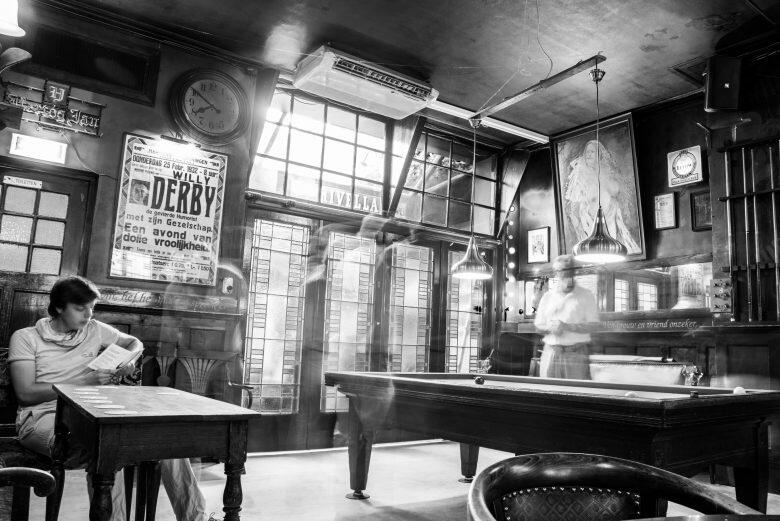
Under the title *Volvolle Vergunning* (Full License), Midas Dekkers wrote an imposing and impressive book about the importance and history of the brown café in the Netherlands. Striking is the considerable attention he devoted to these traditional hospitality establishments in the city and the surrounding countryside. Dekkers, a biologist by training and a convivial storyteller, did not take this lightly. The bibliography at the back of the book lists more than 200 publications that have appeared over the past decades regarding the Dutch brown café. In addition to descriptions of the interiors, Dekkers devotes a remarkable amount of attention to the unwritten laws that apply in these special pubs.
It should come as no surprise that the voluminous commemorative book about café Wolthoorn & Co. (1988) was for him a special guide to delve into the brown café. But also the booklets De verleiding van Groningen by Remco in ’t Hof (1996), Het gevleugelde Café about The Bald Squire (1997) and the Groningen Pub Guide The works of publisher Joris van Berkel (2013) came in very handy when compiling his book *Volvoel Vergunning*. The writings of the Company for the Preservation of Brown Cafés and Taprooms should also not go unmentioned.
This company, founded in 1973—a group of gentlemen who enjoyed frequenting the traditional brown café—was concerned at the time about the future of these special establishments. Not entirely without reason, for in the years that followed, thousands of small and cozy cafés and local pubs in villages and neighborhoods disappeared throughout the Netherlands. Dekkers attributes this not only to changed consumer behavior but certainly also to the government, which, through rigid regulations regarding toilets and dimensions, as well as bans, prevented many proprietors from running a healthy business.
Naturally, the biologist Dekkers cannot resist describing, in a popular scientific manner, the effect of alcohol on the human brain and the physical consequences that excessive drinking can cause. However, he does so with a wink and certainly not with the intention of discouraging visits to a traditional pub. His latest book also describes many anecdotes about the pubs, their regulars, and the unusual incidents that have taken place. During the book's presentation on the television program *De Wereld Draait Door*, an experience involving former Groningen politician Roel Vos at the Amsterdam café Welling was also discussed.
It should come as no surprise that it was the biologist Midas Dekkers who ventured into a pleasant description of the traditional Dutch brown café. His biological father was a pub owner in Haarlem, and when his mother later found love in Amsterdam, this new partner also turned out to run a café. Little Dekkers grew up, as it were, behind the bar and was largely raised by the regulars of his stepfather's café, De Munttoren. Alongside the hymn of praise to the brown café, the author also notes a critical observation. This applies to the Groningen hospitality magnate Sjoerd Kooistra, who died in 2010 and whom Dekkers holds responsible for the demolition of many an original café in the Netherlands. He does, however, note that major Dutch breweries are partly to blame for this devastation by keeping Kooistra in the saddle for so long.
For pub owners, bar staff, and regulars, the book *Volvoele Vergunning* is a must. Dekkers recounts life in the pubs in a particularly pleasant manner and emphasizes the great importance of people meeting in a convivial atmosphere over a drink in the current digital age. An anecdote that did not make it into the book should not go unmentioned.
It must have been at the end of the 1980s that Dekkers sought a seat at the round table in Café Wolthoorn & Co. His eye immediately fell on the attractive barmaid Marijke. He was delighted when she enthusiastically asked if he was indeed Midas Dekkers. Hoping for more than a fleeting encounter, the answer was loud and clear: Yes! To which Marijke coolly remarked that he still had an outstanding bill.
Full License, Midas Dekkers, Bas Lubberhuizen Publishing, 19.99 euros.